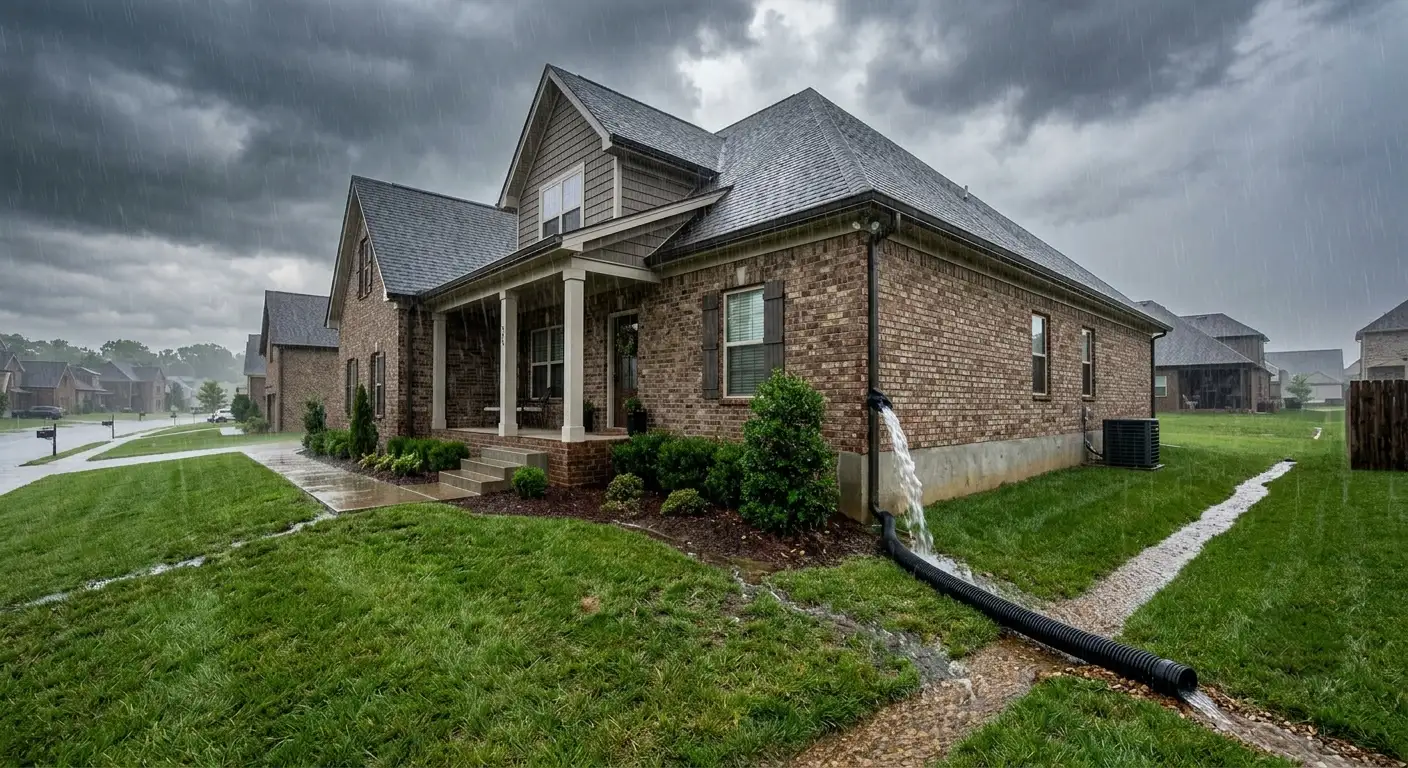
The National Weather Service defines flash flooding as flooding that begins within six hours of heavy rainfall. On Middle Tennessee's clay-heavy soil, homeowners often see water at the foundation in a fraction of that time.
Nashville, Murfreesboro, Franklin, and the surrounding I-24 corridor have logged repeated flash flood warnings this year alone, from summer downpours to fall storm systems. Clay soil drains slowly, so once it's saturated, rain has nowhere to go but toward the nearest low point, usually a foundation, window well, or driveway.
This post breaks down what actually happens to a home during a heavy rainstorm, hour by hour, and what to do before, during, and after to keep water out.
How Fast Does Rain Turn Into Water Damage?
| Storm Stage | What's Happening | What You Should Do |
|---|---|---|
| Before the Storm | Gutters and downspouts start directing runoff toward the foundation. | Confirm downspouts extend 4–6 feet from the foundation and test your sump pump. |
| First Hour of Rain | Saturated soil stops absorbing water; runoff pools near foundations and window wells. | Watch low-lying areas and move valuables off basement floors during a flood watch. |
| 1–3 Hours In | Water pressure builds against foundation walls; seepage can start through cracks or under doors. | Move electronics and belongings to higher ground. |
| 3–6+ Hours (Flash Flood Threshold) | Standing water can enter through the foundation, crawl space vents, or backed-up drains. | Extraction and drying should start immediately; standing water invites mold within 24 to 48 hours. |
Where Does Storm Water Get In?
- Through clogged or undersized gutters and downspouts
- Around foundation cracks and window wells
- Through crawl space vents
- Under exterior doors and low thresholds
- Through sump pumps that fail during power outages
- Through roof flashing and missing shingles
How Mr. Restoration Stops Storm Water Damage Before It Spreads
- 45-minute emergency response. We answer live, 24/7, and dispatch a crew immediately no voicemail, no callback queue.
- Truck-mounted water extraction. Industrial equipment removes standing water from carpets, walls, and structural materials far faster than anything available at a hardware store.
- Structural drying with daily monitoring. Commercial air movers and dehumidifiers run until moisture readings inside walls, under flooring, and in crawl spaces come back safe.
- Thermal imaging and moisture detection. Infrared cameras and moisture meters find hidden water that a visual inspection misses- the water that turns into mold weeks later.
- EPA-approved antimicrobial treatments. Affected surfaces are treated to prevent mold spore colonization after stormwater intrusion.
- Full documentation for insurance. We photograph, measure, and document every step, and communicate directly with your adjuster.
- In-house reconstruction. If drywall, flooring, or structural repairs are needed, our team rebuilds. One company from start to finish.
Don't Wait Out the Next Storm
Every hour water sits against your foundation, the closer you get to a flooded basement and the mold problem that follows. Middle Tennessee's storms move fast, and the timeline for damage moves just as fast.
Mr. Restoration provides 24/7 emergency water damage restoration across Nashville and the I-24 corridor, including Murfreesboro, Franklin, Brentwood, Hendersonville, Manchester, McMinnville, Tullahoma, Winchester, Fayetteville, Smyrna, La Vergne, Shelbyville, and Lebanon.