In Middle Tennessee, crawl space mold is one of the most common findings we encounter — and one of the most consistently underestimated. Here’s how to identify it, and what to do when you find it.
Why Middle Tennessee Crawl Spaces Are Particularly Vulnerable
The region’s climate creates near-ideal conditions for crawl space mold. Hot, humid summers push moisture-laden air into vented crawl spaces from outside. The ground beneath the home releases moisture year-round. And most homes built before the 1990s — the majority of the housing stock in Coffee County, Rutherford County, and surrounding areas — have vented crawl spaces that were the standard construction practice for decades.
Vented crawl spaces were designed to allow air circulation and prevent moisture buildup. In theory, this works. In practice, in Middle Tennessee’s climate, it often has the opposite effect — pulling humid outside air in and creating the persistent moisture conditions that mold needs to establish and spread.
Why Venting Backfires Here
Code-standard vented crawl spaces work well in dry climates. In humid Middle Tennessee, they draw warm outside air onto cool crawl-space surfaces — and moisture condenses out onto joists, insulation, and ductwork.
The Signs That Something Is Wrong
You don’t have to go into your crawl space to get early signals that something is developing down there.
A persistent musty odor
Especially in ground-floor rooms, near HVAC vents, or in the morning when the house has been closed overnight — this is one of the most reliable early indicators. The smell isn’t coming from nowhere. It’s being drawn up from below through gaps in the subfloor and HVAC returns.
Allergy or respiratory symptoms that improve when you leave the house
One caller this year described exactly these symptoms — worsening for months, consistently better when away from home. The crawl space inspection revealed mold on floor joists throughout the space.
Floors that feel soft, spongy, or slightly uneven
This indicates subfloor deterioration from moisture — which almost always means mold is also present in the affected area.
Condensation on windows
In lower areas of the home, or on pipes and HVAC equipment in the crawl space itself.
Higher-than-expected utility bills
A moisture-heavy crawl space makes your HVAC system work harder, and mold on ductwork degrades airflow efficiency.
What You’ll Find If You Look
If you do inspect your crawl space — or have someone inspect it — here’s what active mold problems typically look like:
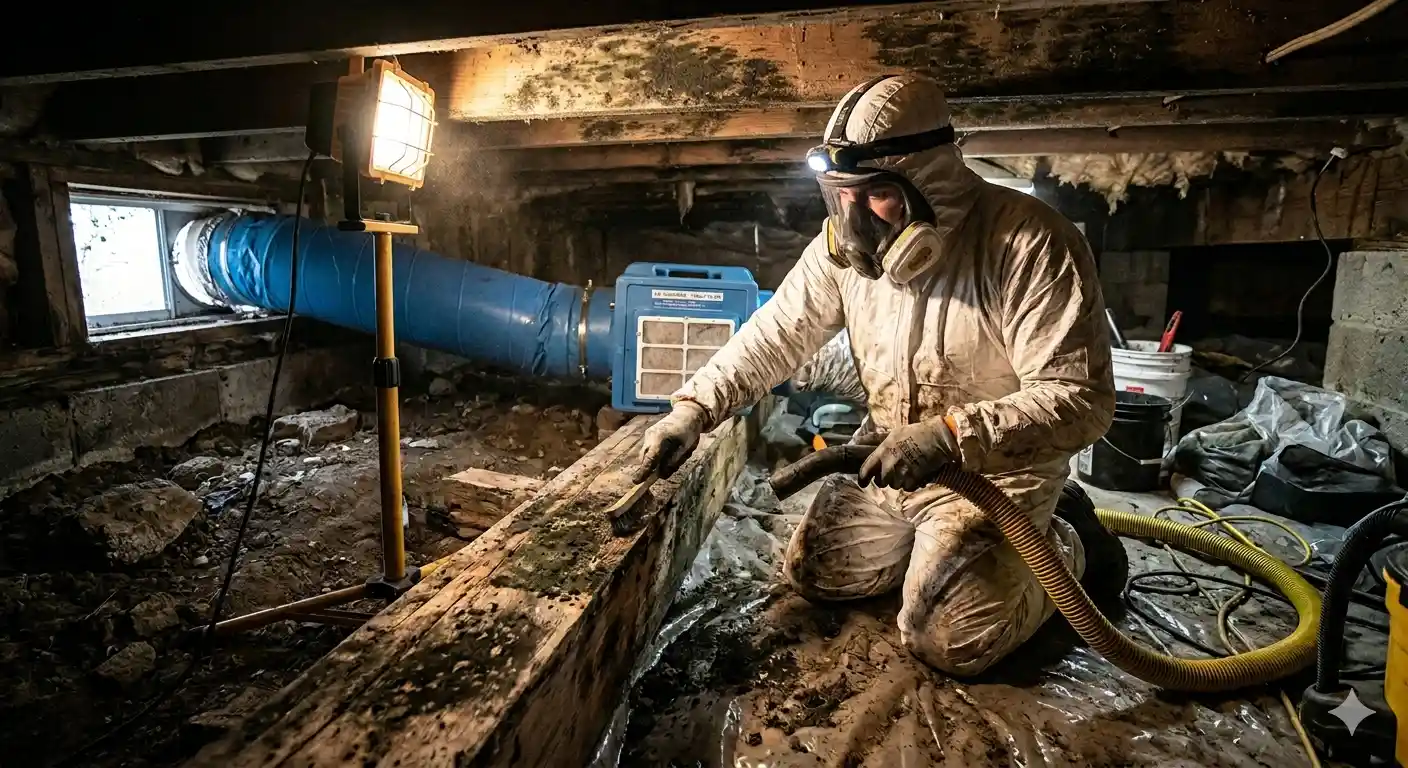
Discoloration on floor joists and wood framing. Black, green, or grey patches on wood surfaces. Mold on wood doesn’t always look dramatic; sometimes it appears as a fuzzy texture or slight darkening rather than a distinct colony.
Sagging or deteriorated insulation. Insulation that has absorbed moisture loses its form and effectiveness. Sagging batts between floor joists are a sign the crawl space has persistent moisture — and where there’s persistent moisture, mold follows.
A deteriorated or absent vapor barrier. If the plastic sheeting on the crawl space floor is cracked, bunched, or missing in areas, the soil below is releasing moisture directly into the space.
Standing water or water staining. Any indication of water that has entered and either remains or has dried without remediation.
One caller found mushrooms — visible fungal fruiting bodies growing at the base of a bathroom wall. That’s advanced growth. By the time mold produces visible surface mushrooms, the colony inside the structure is well established.
What You Should Do
Get a proper inspection first. It assesses the full extent of growth, identifies the moisture source, and gives you an accurate scope of work before any remediation begins. Free with us — no obligation to proceed.
Don’t seal over active mold with encapsulation. Don’t spray bleach on wood and call it done — bleach clears the surface while the colony inside the porous material keeps growing.
Fix the Moisture Source Alongside the Mold
Remediation without correcting the moisture problem means the mold returns. The source — vapor barrier failure, humidity, drainage, or a plumbing leak — has to be resolved as part of the same project, not a later one.
The Air Quality Connection
This is the part that matters most for daily life in the home: your crawl space air doesn’t stay in your crawl space.
The stack effect — warm air rising through a structure and drawing cooler air in from below — means a meaningful portion of the air in your living space originates beneath your home. Mold spores, humidity, and in sewage-affected cases, pathogens, follow the same path into every room.
Addressing crawl space mold isn’t just about the crawl space. It’s about what’s circulating through the air your family breathes.
If you have any of the signs described here — or if you simply haven’t had your crawl space inspected and don’t know its current condition — a free inspection takes less than an hour and gives you a clear, documented picture of what’s there.
We serve Middle Tennessee homeowners throughout Manchester, Tullahoma, Murfreesboro, Shelbyville, Franklin, and surrounding areas. Call or text 615-257-8063 to schedule.